
Insights from Reuters’ AI Momentum: Why responsible AI adoption starts with data and governance

 6 mins
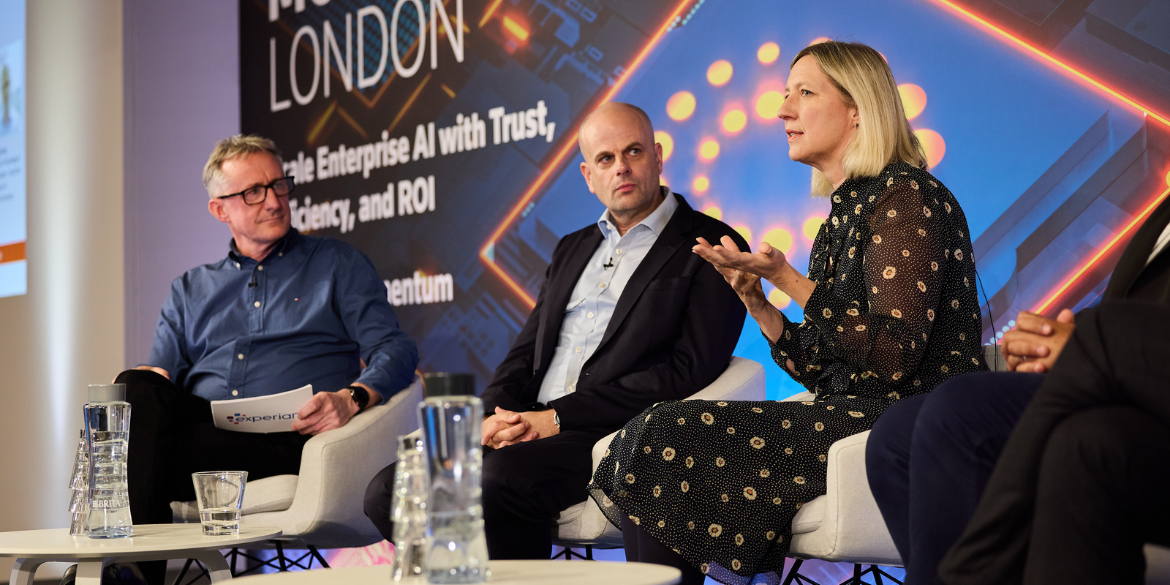
At Reuters’ AI Momentum event in London last month, leaders from across banking, insurance, asset management and technology took to the stage to explore a challenge common to businesses across the finance sector: how to harness AI at scale while safeguarding governance, ethics and trust.
Representing RWS was Christina Scott, our Chief Product and Technology Officer, who joined senior peers from Bank of America, Aviva, Experian and Manulife to discuss the realities of adoption in highly regulated, data-rich industries.
The discussion quickly revealed a shared truth: while hype around AI is deafening, real progress depends on pragmatism, collaboration and responsibility.
From workflows to agentic AI
For Scott, the most exciting development lies in agentic AI – a technology that promises to replace rigid, predefined workflows with dynamic orchestration at scale.
“Traditionally, workflows are static. With agentic AI, we can orchestrate humans and technology dynamically – depending on the risk appetite, the value of the content and the outcome required,” she explained.
This represents a fundamental shift in how organizations handle content, compliance and customer expectations. Instead of sending every task through the same sequence of checks, agentic AI enables adaptive processes. High-risk, high-value projects can pull in human experts while lower-stakes work can be automatically streamlined for speed and efficiency.
Scott stressed though that agentic AI is not “magic.” Its value depends entirely on the quality of underlying data and the clarity of business processes. “If we don’t get those foundations right, pilots will disappoint. The excitement lies in orchestration, but orchestration only works when the instruments are tuned.”
Bank of America’s Andy Price offered a complementary view, grounding agentic AI in tangible outcomes. “We want to solve real business problems that create efficiency and savings. AI has to be measured by outcomes, not just experimentation.”
Avoiding the trap of hype
With new models and breakthroughs announced weekly, distinguishing hype from reality is a universal challenge.
“It’s dangerous to get excited about AI as a product in itself,” Scott warned. “We need to stay focused on customer goals – whether that’s scalability, risk control or cost efficiency.”
Colin Purdie, Chief Investment Officer at Manulife, framed the issue through an investor’s lens. “Yes, there is hype, but AI is transformative. Our job is to understand how it will impact companies and industries in both the short and long term – and to be agile enough to pivot when needed.”
Aviva’s Chief Innovation Officer, Arslan Hananni, described a mindset of curiosity balanced with responsibility: “We sometimes just need to try things in a safe environment with the right guardrails. Curiosity is important, but so is knowing when to move on.”
Pivoting in a rapidly changing landscape
RWS knows first-hand how quickly AI can shift expectations. Having invested heavily in proprietary machine translation, we had to adjust rapidly when large language models (LLMs) redefined what clients expected.
“The breakthrough wasn’t just fluency,” Scott said. “It was the perception that anything was possible, instantly. We had to evolve from closed, proprietary systems to orchestrating MT, LLMs and humans together for the best outcomes.”
This pivot required not just new technology, but a new mindset. Instead of clinging to the established, RWS chose to become an orchestrator – blending the best of open ecosystems with our own capabilities. For customers, this means solutions that are not locked into a single vendor or model, but tailored to the context of their needs.
As Hananni observed from an insurance perspective, agility is now survival: “There’s so much change that sometimes we just need to experiment – provided the right safeguards are in place. Safe experimentation is how we find what really delivers value.”
Governance, assurance and the human factor
One of the strongest themes of the discussion was that AI must never operate unchecked. Assurance, governance and human oversight remain dispensable.
Scott captured the mood succinctly: “The question is no longer just ‘can we do this?’ It’s about trust. How do we measure bias, ensure diversity, protect security? Human verification, feedback loops and transparent governance are critical.”
For Aviva, risk management is second nature. “We’re an insurance company at our core,” Hananni said. “We don’t take governance lightly. For customer-facing use cases, our benchmark is especially high.”
Bank of America’s Price agreed that balancing human and artificial intelligence is non-negotiable. “AI isn’t replacing humans, it’s augmenting them – enabling people to focus on tasks that create more value. A human must always be in the loop where the stakes are high.”
Building a culture of adoption
Technology is one piece of the puzzle; people are the other. Adoption requires more than rolling out new tools – it demands a cultural shift.
Scott described a journey with three stages: awareness, efficiency and transformation. “First comes awareness of what AI can safely do. Next is efficiency – using it to improve existing processes. Finally, it’s about enabling new opportunities we couldn’t deliver before.”
Training plays a pivotal role in this journey. Price noted how Bank of America now offers courses on effective prompting. “Ask the wrong question, and you may not get the answer you need. We’ve had to train people to interact with AI intelligently.”
For Purdie, cultural buy-in is just as critical as technical performance: “We’ve seen people go from skeptics to super-users in weeks – once they see AI solving problems they actually care about.”
Beyond efficiency: Towards strategic value
If there was one shared conclusion, it was this: AI’s long-term promise lies in moving from efficiency gains to strategic transformation.
For RWS, that means orchestrating humans and machines to deliver trusted outcomes at scale. For Bank of America, it means improving client service through personalization and better insights. For Aviva, it means reshaping claims processes to deliver faster, fairer results. And for Manulife, it means making investment professionals more effective by reducing the time spent on data preparation, freeing them to focus on high-value judgment calls.
As Scott concluded: “We mustn’t cling to the past. The real differentiator isn’t who adopts AI fastest, but who adopts it most responsibly.”
Leading the AI era with RWS
Reuters’ AI Momentum event showcased both the opportunities and the pitfalls of this new era. Across industries, leaders agreed that AI cannot succeed without governance, transparency and human expertise.
At RWS, we see this as the foundation of our approach to AI. By combining advanced technologies with the assurance of human expertise, we help organizations adopt AI responsibly – achieving efficiency while protecting trust, ethics and security.
To explore how your organization can navigate the challenges and opportunities of AI with confidence, speak to the RWS team today.