2 days ago

AI, IP and the shift toward portfolio intelligence

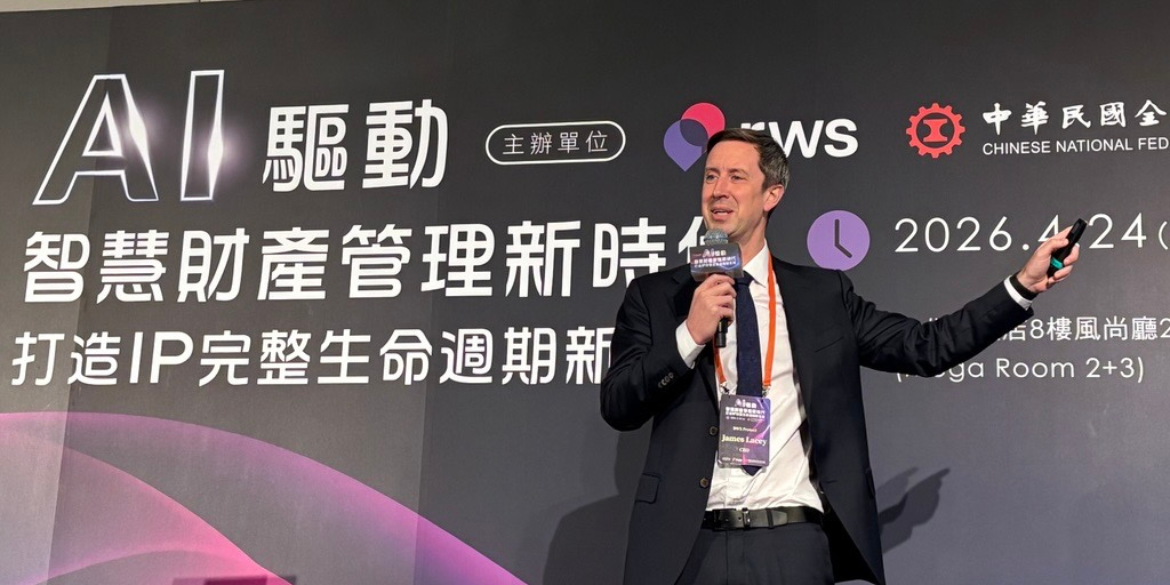
James Lacey at the CNFI Forum in Taipei.
On April 24, RWS partnered with the Chinese National Federation of Industries (CNFI) to host its first customer forum in Taipei: “AI-Driven New Era of IP Management – Building a New Ecosystem for the Full IP Lifecycle.”
 
The forum brought together nearly 200 professionals from the IP and technology community to discuss how artificial intelligence (AI) can support intellectual property (IP) management across the full lifecycle, including invention, application strategy, portfolio management, maintenance, analytics and commercialization.
 
James Lacey, CEO of RWS IP solutions, gave the keynote presentation, “AI x IP: A New Connected Ecosystem for the Full IP Lifecycle.” His session explored how technology, data and expert support are changing the way organizations manage global IP portfolios. After the forum, we spoke to James about his experience in Taipei, the themes behind his presentation and how he sees AI shaping the next phase of IP management.
 
It was James’s first time back in Taipei since 2019, and the pace of change was immediately clear.
 
“First time I have been back in Taipei since 2019 and I’ve been struck by the pace of innovation and willingness to adopt AI solutions,” he said. “This event is special to me since although RWS was founded in 1958 and now has over 7,000 employees globally, it’s our first ever IP focused event in Taipei and I’m looking forward to meeting with over 200 leading IP industry experts.”
 
The event marked an important milestone for RWS IP solutions, bringing clients, partners and senior IP professionals together for a practical discussion about AI, portfolio strategy and the future of IP operations.

A connected view of the IP lifecycle

James’s keynote looked at the IP lifecycle as a connected system, rather than a series of separate tasks. His presentation covered the ways RWS supports clients across patent translations, translations for information, validations, filings, search and monitoring, renewals and recordals.
 
The session reflected the pressures many IP teams are managing today. Portfolios are expanding across more markets, translation requirements are growing, renewal decisions are becoming more complex and internal teams are expected to provide clearer strategic value to the business. These pressures make it harder to manage IP through disconnected tools, fragmented data and manual workflows.
 
James also shared practical examples of technology being applied across IP management. One was Alibaba, where RWS’s renewals solution supports the management of a complex global patent portfolio. His presentation also covered RWS’s crowdsourcing model, which can bring together human diversity, technical knowledge and structured workflows for selected IP research needs.
 
Across the presentation, James returned to the importance of connecting data, workflows and decision-making across the full lifecycle. Filing, translation, renewals, research and portfolio analysis all influence one another, so every decision needs to be understood in context. Choices made during drafting or filing can later affect prosecution, renewal strategy, licensing potential and commercialization opportunities.

AI’s role in IP: automate, assist, transform

When asked how he sees AI and cultural intelligence shaping the future of IP, James described three distinct phases: automate, assist and transform.
 
The first phase is about “embedding workflow automation across service delivery to improve consistency, turnaround time, and scalability, supported by AI-driven execution and orchestration, with established application in areas such as translation workflows.”
 
For IP teams managing work across multiple jurisdictions, this can help reduce variation, speed up repeatable processes and support more consistent delivery. It creates a stronger operational foundation while keeping expert oversight in place where judgment, technical meaning and legal nuance matter.
 
The second phase is about “introducing tools that support professionals In drafting, analysing, and managing portfolio activity, with AI supporting information capture, summarization, and output generation.”
 
This is where AI can add value as a working layer around human expertise. IP professionals still need to judge accuracy, legal nuance, technical meaning and commercial relevance, but AI can help them move through information-heavy tasks with more speed and consistency.
 
The third phase is about “establishing a product-led environment with a transactional platform, unified data model, and integrated workflows, enabled by AI to support automation and decision-making at scale.”
 
For organizations managing large or growing portfolios, this points to an IP environment where transactions, data and workflows are connected in one place. That clearer view can help teams understand the shape of their portfolios, manage activity across markets and make decisions with greater confidence.

A platform and partnerships approach

James was also struck by the way innovation in the region is being shaped by collaboration, ecosystems and strong technology supply chains. He connected this to the way local organizations are approaching AI, electric vehicles and broader industrial growth.
 
He described a distinctive model of expansion built around platforms and partnerships, giving the electric vehicle sector as one example.
 
“The Taiwanese way is to develop and expand using a ‘platform and partnerships’ approach,” he said. “A good example of this approach is in the Electronic Vehicle industry where Taiwan’s approach is not to dominate with one brand, but to export the supply chain ecosystem.”
 
That observation connects closely with the direction of IP management. As innovation becomes more distributed across partners, suppliers, technologies and markets, organizations need more coordinated ways to manage the IP that underpins that growth.
 
James sees a close connection between that approach and the direction of RWS IP solutions.
 
“In fact, the Taiwanese way is aligned to RWS approach in that we will provide the platform and ecosystem for global partners to manage their IP portfolios effectively.”
 

Scaling innovation without losing control

Looking ahead to World IP Day, James’s advice to companies expanding globally was rooted in the practical realities of IP operations. Growth brings more filings, more translation requirements, more brand-protection needs and greater responsibility for protecting trade secrets.
 
“As companies expand globally, they are going to need to manage multiple patent filing and translations, protection for new brands and diligence to keep trade secrets,” he said.
For many organizations, that kind of expansion has traditionally been seen as an added cost. More markets often mean more administrative work, more outside counsel coordination, more renewal decisions and more pressure on teams already being asked to stretch their resources.
 
“Traditionally, this type of expansion would have been viewed as an increase to the cost base and IP departments would be challenged ‘to do more with less’. However, I would encourage companies to adopt an approach where IP portfolios can be optimised.”
 
Optimization changes the conversation. Instead of treating IP as a growing list of tasks, organizations can look at the portfolio as a strategic asset that needs active management across its full lifecycle. That means making better decisions about what to protect, where to protect it, how to draft and file applications, and which assets are most likely to support future commercial value.
 
The timing of those decisions matters. As James put it: “This can be achieved through making better portfolio based decisions – making the right decisions when drafting or filing an IP application can have significant downstream impact when maximising monetisation opportunities for your portfolio.”
 
This is where AI-enabled workflows, unified data and expert judgment can work together. AI can help process and organize information, while connected platforms can give teams a clearer view across the portfolio. The value comes from the decisions that follow: which markets to prioritize, which assets to maintain, where risks are emerging and where monetization opportunities may exist.

The next phase of IP management

The Taipei forum showed how quickly the IP conversation is changing. AI is already part of the discussion across translation workflows, drafting support, portfolio management, search, renewals and decision-making. The next phase will depend on how these capabilities come together across the full lifecycle.

James’s perspective points to a future where IP teams manage portfolios with more visibility, coordination and commercial intent. As portfolios grow, teams need systems that connect activity across markets and workflows, while keeping expert judgment at the center of decisions that carry legal, technical and financial consequences.

That is the shift from IP management to portfolio intelligence: a more connected way to protect ideas, guide investment and create long-term value from innovation.

Click here to learn more about our IP Solutions.

Photo of Sarah Donnelly from RWS

Author

Sarah Donnelly

Global Content Strategist

Sarah has worked as a copywriter for more than 20 years. She has written for broadsheet newspapers, magazines and corporate publications across a wide range of sectors. Prior to joining RWS she headed up the marketing department of mid-size company within the energy sector. She now looks after content for the intellectual property division of RWS. 
All from Sarah Donnelly

Related Articles