
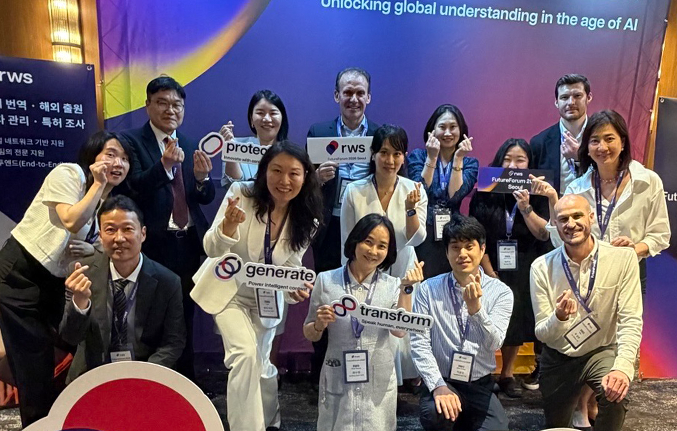
FutureForum 2026 has been taking shape across Asia, and our Seoul event – the second of the series – built on strong momentum from the first stop in Tokyo. Around 40 senior leaders joined us from across entertainment, media, AI, consumer goods, e-commerce, IT services, semiconductors, automotive, healthcare, chemicals and legal sectors. The day ran across three tracks: Transform, covering AI-powered content adaptation; Generate, focused on the data that makes AI models reliable; and Protect, addressing how organizations safeguard intellectual property, brands and innovation assets.

RWS CEO Ben Faes opened the day making the case for cultural intelligence as the missing layer in enterprise AI – the argument that as AI accelerates content creation at scale, the ability to adapt and protect that content across languages, cultures and markets becomes the central challenge for global businesses. In Seoul, this had particular resonance. Korea is one of the world's leading exp of culture, technology and consumer brands, and the challenge of taking a distinctive creative voice to global audiences without losing what made it work in the first place was a concern for many in the room.
Scaling content without losing the story
The Transform and Generate sessions – covering AI-powered content adaptation and the data that makes AI models reliable – opened up territory that hadn't featured in Tokyo: AI dubbing. Given Korea's position as a global force in entertainment and media content, the topic landed with a specific kind of relevance.
When content travels – whether that's a training video, a product launch or branded storytelling – how it sounds in another language matters as much as what it says. AI dubbing has moved a long way from synthetic-sounding voice replacements. Using voice cloning technology, it recreates the speaker's natural tone, pitch and pace across languages, so a video retains the feel of the original rather than sounding like a different production. For organizations managing large volumes of video content across multiple markets, the practical gains are significant – AI dubbing can reduce production times from months to days and cut costs by up to 90% compared to traditional methods. The session also covered how dubbing sits within a broader localization toolkit alongside subtitling, voiceover and transcreation, and how the right combination depends on content type, audience expectations and the level of emotional nuance required.
A session on AI training data made the case that enterprise models are only as reliable as the human expertise built into their training and validation. Attendees from AI, consulting and technology organizations showed strong interest in real-world use cases and practical approaches to balancing automation with quality control, particularly around multilingual content operations.

IP in the AI era
The Protect sessions – focused on helping organizations safeguard intellectual property, brands and innovation assets – drew professionals from semiconductors, automotive, healthcare, chemicals and legal services, all sectors where IP is central to competitive advantage and where the implications of AI are still being worked through in practice.
A guest speaker from a leading Korean IP law firm explored how AI is reshaping the country's IP landscape, covering emerging industry trends, regulatory considerations and the practical implications for professionals managing portfolios in a fast-moving environment. The session complemented our own presentation on how AI fits across the full IP lifecycle, from filing and translation through to brand protection and renewal management.
Our recent acquisition of Obviously – an AI-enabled platform for IP and brand management, protection and enforcement – featured prominently in the discussions. As Korean brands expand across global digital marketplaces, monitoring and responding to counterfeiting, unauthorized sellers and brand misuse has become an operational priority alongside the more traditional legal dimensions of IP protection. Attendees raised substantive questions about accuracy and accountability in AI-driven IP workflows, and the continued importance of human oversight came through clearly in the Q&A.
Ben also spoke with e-Patent News, a specialist publication covering intellectual property for the Korean market, discussing how the role of IP is evolving in the AI era and Korea's strategic importance as one of the world's leading innovation markets.
Closing the day
The event closed with a networking session that brought together attendees from both tracks – a useful opportunity for cross-sector conversation between content and IP professionals. Throughout the day, attendees had direct access to RWS subject matter experts across all three areas of our business, and the discussions reflected a consistent theme: organizations across industries are moving past the question of whether to adopt AI, and are now focused on how to do it with confidence.
If you'd like to talk through how any of this applies to your organization, get in touch.
Tags:
Intellectual Property
Author
Sarah Donnelly
Global Content Strategist
Sarah has worked as a copywriter for more than 20 years. She has written for broadsheet newspapers, magazines and corporate publications across a wide range of sectors. Prior to joining RWS she headed up the marketing department of mid-size company within the energy sector. She now looks after content for the intellectual property division of RWS.